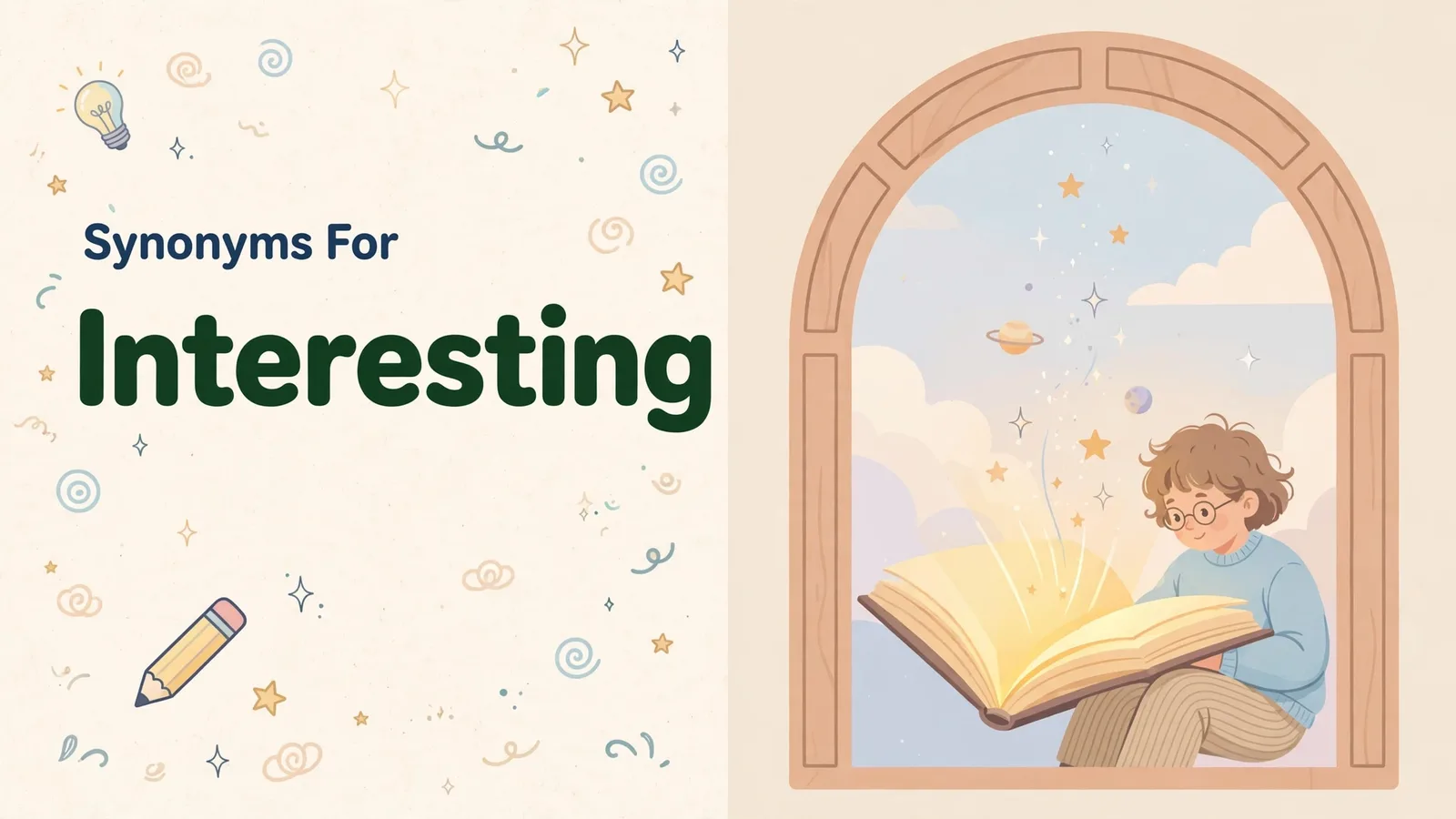
What Does Interesting Mean?
Interesting means something holds your attention and makes you want to know more. The closest synonym is fascinating, because it shows the same pull on your attention, only stronger. People use interesting for books, films, people, places, and ideas that feel fresh, surprising, or worth exploring every day.
Sara, a 14 year old student in Austin, Texas, had to write a book report. Her teacher, Mr. Lopez, circled one word again and again in red pen: interesting. Sara had used it seven times in just two pages, and every sentence sounded the same.
Interesting is a fine word, but it tells the reader little. It does not show if a story made you laugh, made you think, or made you hold your breath. English gives you many sharper synonyms for interesting, and each one paints a clearer picture.
By the end, you will know 12 strong words like interesting, what each one means, and how to use it in your own sentences.
Table of 12 Synonyms for Interesting
| No. | Synonym | Part of Speech | Simple Meaning |
|---|---|---|---|
| 1 | Fascinating | Adjective | Holds your attention completely and strongly |
| 2 | Engaging | Adjective | Holds attention in a pleasant way |
| 3 | Intriguing | Adjective | Makes you curious through hidden mystery |
| 4 | Captivating | Adjective | Holds attention like a gentle spell |
| 5 | Compelling | Adjective | So strong you cannot look away |
| 6 | Absorbing | Adjective | Takes all of your full attention |
| 7 | Gripping | Adjective | Exciting and hard to stop watching |
| 8 | Curious | Adjective | Unusual and worth a closer look |
| 9 | Exciting | Adjective | Full of energy and lively action |
| 10 | Appealing | Adjective | Pleasant and attractive to your mind |
| 11 | Stimulating | Adjective | Wakes up your mind with ideas |
| 12 | Thought-provoking | Adjective | Makes you think deeply long afterwards |
Table of Contents
- Introduction
- Table of 12 Synonyms for Interesting
- Quick Facts About Interesting
- Meaning and Usage of Interesting
- 1. Fascinating
- 2. Engaging
- 3. Intriguing
- 4. Captivating
- 5. Compelling
- 6. Absorbing
- 7. Gripping
- 8. Curious
- 9. Exciting
- 10. Appealing
- 11. Stimulating
- 12. Thought-provoking
- Antonyms of Interesting
- Words Commonly Confused with Interesting
- Frequently Asked Questions
- Conclusion
Quick Facts About Interesting
- Focus keyword: synonyms for interesting
- Part of speech: Adjective
- Simple pronunciation: IN-truh-sting
- IPA: /ˈɪntrəstɪŋ/
- Syllables: 4 written parts (in-ter-est-ing), usually spoken as 3
- Word origin: From “interest,” which comes from the Latin word “interesse,” meaning “to be important” or “to matter.” Long ago, it first meant a thing that truly mattered to you.
- Other word forms: interestingly (adverb), uninteresting (opposite adjective), interest (noun and verb)
- Formality level: Neutral, safe in formal and informal writing
- Difficulty level: Easy
- CEFR level: A2
Meaning and Usage of Interesting
Interesting describes a person, place, thing, or idea that holds your attention and makes you curious. Your mind stays awake, and you want to learn more.
People use this word for books, films, lessons, conversations, jobs, and travel stories. A science lesson can be interesting, and so can a stranger on a train. It is one of the most common words in English, so stronger synonyms help a lot.
For example: “The article about deep sea fish was so interesting that Jonah read it twice.” Or: “Maria found the old photo interesting and asked her grandmother about it.”
1. Fascinating
Meaning: Fascinating means extremely interesting, so strong that it holds your whole attention and you cannot stop reading or watching.
Examples:
- The space documentary was so fascinating that Ahmed watched all three parts in one night in Cairo.
- At the science museum in Chicago, the giant dinosaur skeleton was the most fascinating thing Lily had ever seen.
2. Engaging
Meaning: Engaging means interesting in a warm and pleasant way, so people happily pay attention.
Examples:
- Ms. Carter is an engaging teacher, and her 28 students in Denver listen to her stories until the last minute of class.
- The travel blog was so engaging that Priya read 14 posts about Japan before she made dinner.
3. Intriguing
Meaning: Intriguing means interesting because something feels hidden or mysterious, so your mind keeps asking questions.
Examples:
- The old map had an intriguing red mark near the river, and Hassan spent two weekends trying to find that hidden spot.
- Her new novel opens with an intriguing question: why did the letter arrive at the house 40 years late?
4. Captivating
Meaning: Captivating means so interesting and beautiful that it holds your attention completely, almost like a gentle spell.
Examples:
- The singer gave a captivating performance, and 600 people in the Vienna hall stayed silent until the final note.
- From the first page, the story was so captivating that Zoe read 120 pages on the train ride to Paris.
5. Compelling
Meaning: Compelling means so strong and interesting that you feel you must keep reading, watching, or listening.
Examples:
- The podcast told a compelling story about a lost city, and Omar shared it with 30 friends that day.
- Her speech about ocean plastic was so compelling that 200 students signed up for the beach cleanup that weekend.
6. Absorbing
Meaning: Absorbing means so interesting that it takes all your attention, and you forget the time.
Examples:
- The puzzle was so absorbing that Ben worked on its 1,000 pieces for five hours straight.
- Grandpa Joe finds his garden truly absorbing; he spends three hours there every morning in his small Irish village.
7. Gripping
Meaning: Gripping means interesting in a tense way, so it is almost impossible to stop reading or watching.
Examples:
- The final chapter of the mystery was so gripping that Fatima read it twice on the bus ride home to Karachi.
- It was a gripping football match in Madrid, and the home team scored the winning goal in the 89th minute.
8. Curious
Meaning: Curious, when it describes a thing, means unusual and interesting, and it makes you stop and look closer.
Examples:
- The antique shop in Istanbul sold a curious clock with 13 numbers on its face instead of 12.
- A curious green stone on the beach made all six children in Goa stop their game and gather around it.
9. Exciting
Meaning: Exciting means interesting because it is full of energy, action, or something new about to happen.
Examples:
- The school science fair was exciting this year, because a team from Seoul built a robot that could dance.
- Our trip to the Grand Canyon sounds exciting, and Mia has already packed her camera and two notebooks for it.
10. Appealing
Meaning: Appealing means interesting and attractive in a pleasant way, so the idea feels good at once.
Examples:
- The idea of a quiet weekend in the mountains was so appealing that Sara booked a small cabin for six friends.
- With its bright cover and short chapters, the book looked appealing to young readers at the fair in Nairobi.
11. Stimulating
Meaning: Stimulating means interesting in a way that wakes up your mind with fresh energy and ideas.
Examples:
- The debate at the university in Berlin was so stimulating that students kept discussing it for two hours afterwards.
- After the talk, Mr. Lee said it was the most stimulating lecture he had heard in his 20 years of teaching.
12. Thought-provoking
Meaning: Thought-provoking means interesting because it makes you think deeply, often long after you finish reading or watching.
Examples:
- The film ends with a thought-provoking question about what makes a good life.
- Her thought-provoking essay about city parks won first prize in the school contest in Melbourne last spring.
Antonyms of Interesting
| # | Antonym | Simple Meaning | Example |
|---|---|---|---|
| 1 | Boring | Not interesting at all | The three hour lecture in Room 12 was so boring that half the class fell asleep. |
| 2 | Dull | Boring and without any life | The old textbook was dull, with gray pages and not a single picture. |
| 3 | Uninteresting | Holds no attention in any way | Tom found the museum tour uninteresting and quietly left after ten minutes. |
| 4 | Monotonous | Always the same, never changing | Her monotonous job of stamping 500 envelopes a day tired Amina quickly. |
| 5 | Tedious | Boring because it is slow and long | Copying 40 pages by hand was tedious work for the young clerk. |
| 6 | Plain | Simple, with nothing special to notice | The plain white room had no color, no art, and nothing to look at. |
Words Commonly Confused with Interesting
Interested
Difference: Interested describes a person who feels attention and curiosity. Interesting describes the thing that causes that feeling. If you say “I am interesting,” you claim that other people find you interesting, a very different claim.
Example: Nina is interested in astronomy, so she finds every book about the planets interesting.
Fun
Difference: Fun means enjoyable and playful. A serious history lesson can be interesting without being fun, and a silly game can be fun without teaching you anything.
Example: The museum visit was interesting, and the treasure hunt game at the end was pure fun for the kids.
Amusing
Difference: Amusing means funny in a light, pleasant way. Interesting is wider and does not need humor at all. A deep ocean mystery can be interesting, but it is not amusing.
Example: The clown told amusing little stories, and all 30 children at the birthday party laughed loudly.
Excited
Difference: Excited describes a strong happy feeling, usually before something happens. Interesting describes a thing that pulls your attention. People feel excited about interesting events.
Example: The students felt excited all morning because the afternoon science show promised to be very interesting.
Frequently Asked Questions
What is another word for interesting?
The most common other words for interesting are fascinating, engaging, and captivating. Fascinating is the strongest choice, engaging fits talks, teachers, and warm stories, and captivating fits performances and books that hold you fully. Intriguing, gripping, and absorbing are also safe options.
What is the closest synonym for interesting?
Fascinating is the closest and strongest synonym for interesting. Both pull your full attention, but fascinating adds more power. If a book is merely good, interesting is enough. If you could not put it down for three hours, fascinating is the better word.
What is the difference between interesting and interested?
Interesting describes the thing, and interested describes the person. A film is interesting, and you feel interested. Many learners mix these two in exams and interviews. A simple memory trick helps: the thing is interesting, so I am interested. Keep the person with “interested” every time.
Is interesting a formal or informal word?
Interesting is a neutral word, so it fits both formal essays and daily conversation too. In school essays and book reports, teachers ask for stronger synonyms like fascinating or thought-provoking. In job interviews, engaging and compelling sound professional, clear, and confident.
What is the opposite of interesting?
The main opposites of interesting are boring, dull, and uninteresting. Boring is the most common and fits almost any situation. Dull often describes books, lessons, or talks with no life in them. Monotonous fits things that repeat without change, like the same task done every single day.
Which synonym is best for a book or film?
For a book or film, gripping fits exciting stories and thrillers, captivating fits beautiful or emotional ones, and absorbing fits long stories. Thought-provoking is best for a work that makes you think after it ends. Reviewers mix these words to show how a story held attention.
Conclusion
Interesting is a useful word, but it is only the beginning. Fascinating adds power, gripping adds excitement, and thought-provoking shows that something stayed in your mind. When you choose synonyms for interesting with care, your emails, essays, and conversations become clearer and far more alive. Always match the word to the context, because the right small word beats a vague big one. You can check the dictionary entry for interesting for more examples. Here is your 30-second challenge: pick one synonym from this list and use it in a sentence today. Small daily practice builds a vocabulary people remember.