Featured Snippet Answer
The closest synonym for clarification is explanation. Both words mean making something easier to understand. Other good options include elucidation, explication, and simplification. Use explanation in everyday talk, and choose elucidation or explication in formal or academic writing. Context decides which word sounds most natural.
Picture this. Your manager sends a long email, and you are not sure what the deadline is. You reply, “Could I get a quick clarification?” A minute later, everything makes sense.
“Clarification” means making something clear or easy to understand. We ask for it when a message is confusing, and we give it when we explain something better. It is a useful word, but it can sound stiff or repetitive if you use it again and again.
That is why synonyms for clarification are worth learning. Different words fit different situations, from casual chats to formal reports. Below, you will find 14 other words for clarification, with simple meanings, short comparisons, and real-life examples. Choose the one that fits your sentence best.
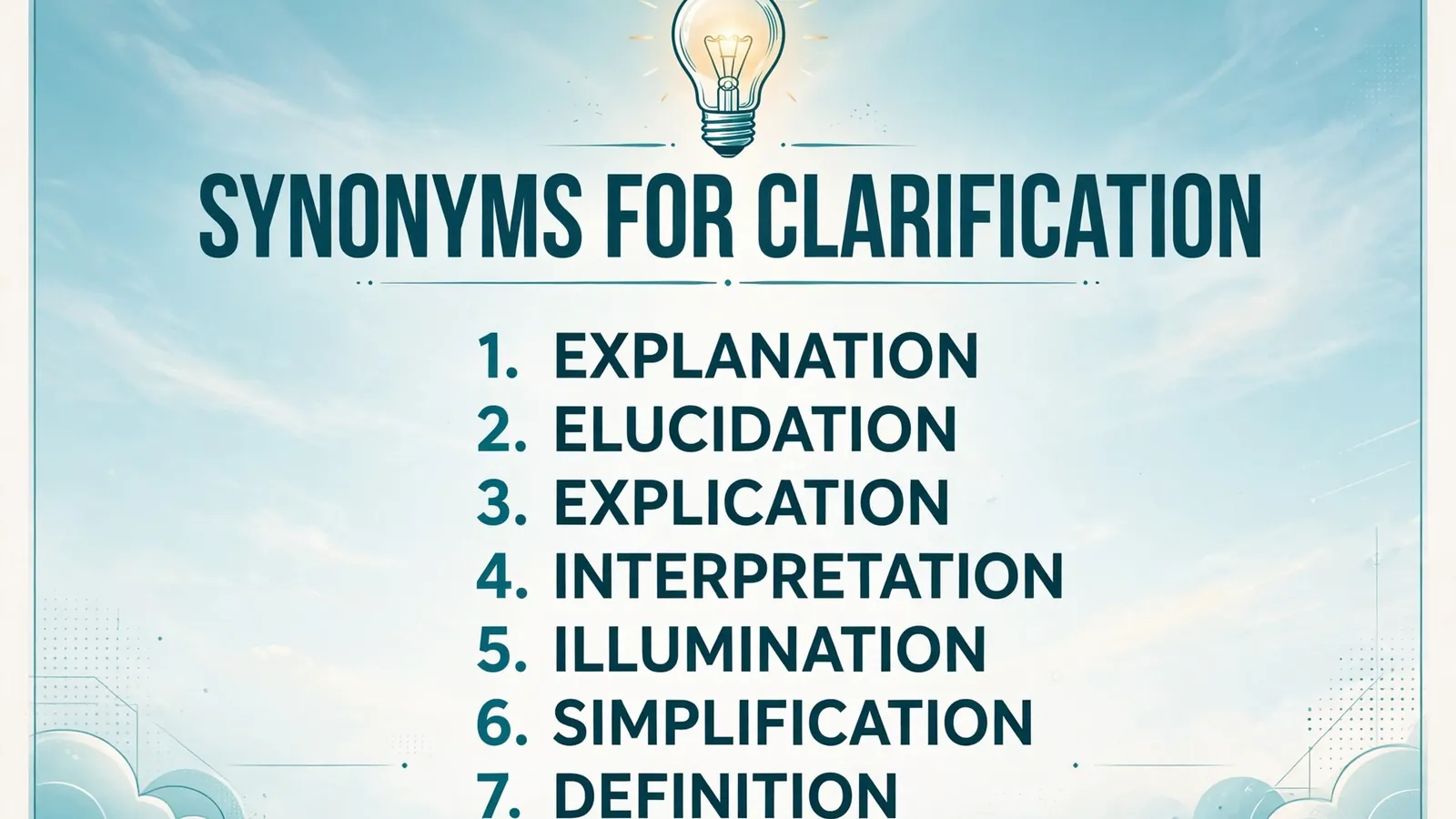
Synonyms for Clarification
| # | Synonym | Simple Meaning |
|---|---|---|
| 1 | Explanation | A statement that makes things clear |
| 2 | Elucidation | A detailed, clear explanation |
| 3 | Explication | A careful, in-depth analysis |
| 4 | Simplification | Making something easier to understand |
| 5 | Interpretation | An explanation of what something means |
| 6 | Illumination | Making a topic clearer, like shining light |
| 7 | Exposition | A full and clear explanation |
| 8 | Definition | A statement of exact meaning |
| 9 | Demystification | Removing confusion from a topic |
| 10 | Disambiguation | Removing doubt between meanings |
| 11 | Specification | Stating exact, clear details |
| 12 | Clarity | The quality of being clear |
| 13 | Enlightenment | Gaining a clear understanding |
| 14 | Amplification | Adding detail to make clearer |
Table of Contents
- Explanation
- Elucidation
- Explication
- Simplification
- Interpretation
- Illumination
- Exposition
- Definition
- Demystification
- Disambiguation
- Specification
- Clarity
- Enlightenment
- Amplification
Quick Facts About Clarification
- Focus keyword: clarification
- Part of speech: Noun
- Simple pronunciation: klair-uh-fih-KAY-shun
- IPA: /ˌklærəfɪˈkeɪʃən/ (US)
- Syllables: 5 (clar-i-fi-ca-tion)
- Word origin: It comes from the verb “clarify,” which goes back to the Latin word clarus, meaning “clear.”
- Other word forms: clarify (verb), clarified, clarifying
- Formality level: Neutral to formal
- Difficulty level: Intermediate
Meaning and Usage of Clarification
Clarification is the act of making something clear. It can also mean the explanation that removes confusion.
People often use it in these contexts:
- Work emails and meetings (“I need a clarification on the schedule.”)
- School and exams (“Ask the teacher for clarification.”)
- Contracts, rules, and official notices
Examples:
- Can you give me a clarification on the refund policy?
- The teacher’s clarification helped the whole class.
1. Explanation: A Synonym for Clarification
Relationship: Near synonym
Direct Replacement: Yes
Difficulty Level: Beginner
Meaning: An explanation is a statement that makes something easy to understand.
Difference: Explanation is broader and more common. Clarification usually fixes a specific point of confusion.
Best Used For: Daily conversation, academic writing, business writing
Examples:
- She gave a quick explanation of how the app works.
- I need an explanation for why the bill went up.
2. Elucidation: A Synonym for Clarification
Relationship: Exact synonym
Direct Replacement: Sometimes
Difficulty Level: Advanced
Meaning: Elucidation is a detailed explanation that makes a hard topic clear.
Difference: Elucidation is more formal and often sounds academic, while clarification is more everyday.
Best Used For: Academic writing, literature, formal writing
Examples:
- The professor’s elucidation of the poem made it much easier to follow.
- The report ends with a short elucidation of the main findings.
3. Explication: A Synonym for Clarification
Relationship: Near synonym
Direct Replacement: Sometimes
Difficulty Level: Advanced
Meaning: Explication is a careful, detailed explanation, often of a text or an idea.
Difference: Explication goes deeper and is used for analysis, while clarification can be a quick fix.
Best Used For: Academic writing, literature
Examples:
- Her explication of the legal clause took two full pages.
- The class spent an hour on the explication of one short paragraph.
4. Simplification: A Synonym for Clarification
Relationship: Contextual alternative
Direct Replacement: Sometimes
Difficulty Level: Intermediate
Meaning: Simplification means making something easier to understand or do.
Difference: Simplification removes difficulty, while clarification removes confusion. It may also leave out some detail.
Best Used For: Daily conversation, business writing, technical writing
Examples:
- The new form is a big simplification of the old process.
- A simplification of the rules helped new players join in.
5. Interpretation: A Synonym for Clarification
Relationship: Contextual alternative
Direct Replacement: Sometimes
Difficulty Level: Intermediate
Meaning: Interpretation is an explanation of what something means.
Difference: Interpretation can be a personal view, while clarification aims to give a clear, agreed meaning.
Best Used For: Academic writing, literature, creative writing
Examples:
- My interpretation of his message was that he wanted more time.
- Different readers offer different interpretations of the ending.
6. Illumination: A Synonym for Clarification
Relationship: Contextual alternative
Direct Replacement: No
Difficulty Level: Advanced
Meaning: Illumination means making a topic clearer, like shining a light on it.
Difference: Illumination is more poetic and works best in writing, while clarification is plain and practical.
Best Used For: Creative writing, literature
Examples:
- The documentary offered real illumination on how bees communicate.
- Her story brought illumination to a topic few people understood.
7. Exposition: A Synonym for Clarification
Relationship: Contextual alternative
Direct Replacement: No
Difficulty Level: Advanced
Meaning: Exposition is a full, clear presentation of facts or ideas.
Difference: Exposition lays out a whole topic, while clarification answers a single point of confusion.
Best Used For: Academic writing, literature
Examples:
- The first chapter is a clear exposition of the theory.
- His exposition on tax law was easy to follow.
8. Definition: A Synonym for Clarification
Relationship: Contextual alternative
Direct Replacement: Sometimes
Difficulty Level: Beginner
Meaning: A definition states exactly what a word or idea means.
Difference: Definition is about meaning only, while clarification can explain situations, plans, or instructions.
Best Used For: Daily conversation, academic writing, technical writing
Examples:
- The contract needs a better definition of “working day.”
- Can you give me a definition of that term?
9. Demystification: A Synonym for Clarification
Relationship: Near synonym
Direct Replacement: Sometimes
Difficulty Level: Advanced
Meaning: Demystification means taking away confusion from something that seems complicated.
Difference: Demystification suggests the topic felt mysterious or scary before, while clarification is more neutral.
Best Used For: Business writing, blogs, creative writing
Examples:
- The workshop aimed at the demystification of personal finance.
- Her video series is a friendly demystification of coding.
10. Disambiguation: A Synonym for Clarification
Relationship: Contextual alternative
Direct Replacement: No
Difficulty Level: Advanced
Meaning: Disambiguation means removing doubt when a word or term has more than one meaning.
Difference: Disambiguation is narrower and technical, while clarification works for any confusion.
Best Used For: Technical writing, academic writing
Examples:
- The site has a disambiguation page for the name “Mercury.”
- The editor added a note for disambiguation between the two authors.
11. Specification: A Synonym for Clarification
Relationship: Contextual alternative
Direct Replacement: No
Difficulty Level: Intermediate
Meaning: Specification means stating exact and clear details.
Difference: Specification focuses on precise details, while clarification fixes confusion.
Best Used For: Business writing, technical writing
Examples:
- The client sent a full specification for the new website.
- Please provide a specification of the delivery times.
12. Clarity: A Synonym for Clarification
Relationship: Related term
Direct Replacement: No
Difficulty Level: Beginner
Meaning: Clarity is the quality of being clear and easy to understand.
Difference: Clarity is a quality, while clarification is an action or an explanation. It is a related term, not a direct synonym.
Best Used For: Daily conversation, academic writing, business writing
Examples:
- The speech had great clarity, so everyone understood the plan.
- I need more clarity about my role.
13. Enlightenment: A Synonym for Clarification
Relationship: Related term
Direct Replacement: No
Difficulty Level: Intermediate
Meaning: Enlightenment means gaining a deeper, clearer understanding of something.
Difference: Enlightenment is the result of understanding, often a deeper one, while clarification is the act of explaining. It is a related term, not a direct synonym.
Best Used For: Creative writing, literature
Examples:
- A week in the library brought him real enlightenment about local history.
- She felt a moment of enlightenment when the math problem finally clicked.
14. Amplification: A Synonym for Clarification
Relationship: Related term
Direct Replacement: No
Difficulty Level: Advanced
Meaning: Amplification means adding more detail to make an idea fuller and clearer.
Difference: Amplification adds extra information, while clarification clears up what is already there. It is a related term, not a direct synonym.
Best Used For: Academic writing, business writing
Examples:
- The editor asked for amplification of the second paragraph.
- His speech needed some amplification to make the point stronger.
Antonyms of Clarification
| # | Antonym | Simple Meaning | Example |
|---|---|---|---|
| 1 | Confusion | A state of not understanding | The new rules caused a lot of confusion. |
| 2 | Obscurity | The state of being unclear | The meaning of the old note is lost in obscurity. |
| 3 | Ambiguity | Having more than one possible meaning | The ambiguity in the contract led to an argument. |
| 4 | Vagueness | Lack of clear detail | The vagueness of her answer worried me. |
| 5 | Mystification | Making something harder to understand | The long speech ended in total mystification. |
| 6 | Complication | A thing that makes matters harder | A late payment added a new complication. |
| 7 | Misunderstanding | A wrong idea about what something means | A small misunderstanding ruined the plan. |
Words Commonly Confused with Clarification
Clarify
Difference: “Clarify” is a verb that means to make clear. “Clarification” is the noun for the act or the explanation.
Example: Could you clarify what time the meeting starts?
Clarity
Difference: “Clarity” is the quality of being clear. “Clarification” is something you give or ask for to reach that clarity.
Example: The manager spoke with great clarity.
Classification
Difference: “Classification” means sorting things into groups. It sounds similar, but it has nothing to do with explaining.
Example: The classification of the books took all afternoon.
Verification
Difference: “Verification” means checking that something is true. Clarification explains something, while verification confirms it.
Example: The bank asked for verification of my address.
FAQs
What is another word for clarification?
Another word for clarification is explanation, elucidation, or simplification. In everyday talk, “explanation” is usually the best choice. In formal or academic writing, words like “elucidation” and “explication” sound more polished. Pick the word that matches your audience and your tone.
What is the closest synonym for clarification?
The closest synonym for clarification is explanation. Both words mean making something clear and easy to understand. Explanation is the more common and flexible word, so it works in emails, classrooms, and casual chats. “Elucidation” is another close match for formal writing.
Can I replace clarification with explanation?
Yes, in most cases. “Explanation” is a safe and natural replacement. The small difference is that clarification often fixes one point of confusion, while explanation can cover a whole topic. For example, “I need a clarification” and “I need an explanation” both sound fine.
Is clarification formal or informal?
Clarification is neutral to slightly formal. You can use it in work emails, school, and everyday speech without sounding odd. For a more casual tone, say “explanation” or “clearing things up.” For a more formal tone, try “elucidation” or “explication.”
What is the opposite of clarification?
The opposite of clarification is confusion, ambiguity, or vagueness. These words describe a lack of clear meaning. For example, a muddled message creates confusion, while a clear reply gives clarification. Words like “obscurity” and “misunderstanding” also work as opposites.
Which synonym is best for work emails?
For work emails, “explanation,” “specification,” and “definition” work well. Use “explanation” when someone is confused, “specification” when you need exact details, and “definition” when a term is unclear. Keep your words simple and polite so the message is easy to read.
Conclusion
Learning synonyms for clarification gives you more ways to explain, ask, and teach. A richer vocabulary makes your writing clearer, and it keeps your emails and essays from sounding repetitive.
Remember that context matters. “Explanation” fits a daily chat, “elucidation” suits formal writing, and “specification” works best when you need exact details. Choose the word that fits the situation.
Try these words in your next email, essay, article, or conversation. With a little practice, the right word will come.